Case studiesSaaS StartupNDA

How a new AI app builder up against Lovable and Replit grew AI + organic traffic +493% in 3 months.

Published · Updated

SaaS startup · Launched June 2026 · No blog, no third-party content · GA4 and Search Console verified

How can a new SaaS product get named in AI answers?

Give AI a reason to trust it. This AI app builder launched with no blog and no third-party content, and AI named it in 0 of 2,580 answers. We built a page for each buyer question and got it onto sites AI trusts. Six weeks after the first article, Google's AI answer named it first.

+493%Organic and AI search trafficMonth 3 vs month 1 (Aug vs Jun 2026)
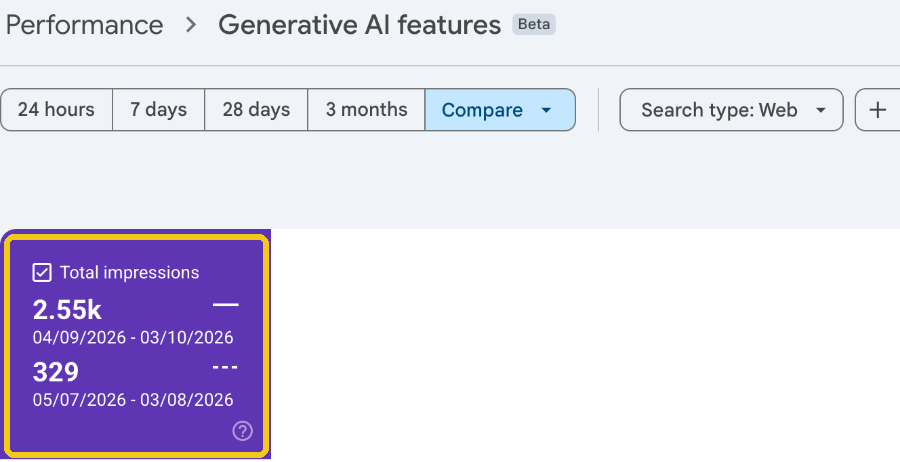
+676%Impressions in Google's AI answers5 Jul - 3 Aug vs 4 Sep - 3 Oct 2026
+1,372%Google impressions for searches that don't name the brand5 Jul - 3 Aug vs 4 Sep - 3 Oct 2026
6 weeksfrom the first article to being named first in a Google AI answer6 Jul-16 Aug 2026

Sources: client GA4, Google Search Console (incl. the Generative AI features report) and Google AI answer captures. Search Console has no data before 5 Jul 2026, so its baseline is its first 30 days.

Key takeaways

  • Starting point: a brand-new site with only its homepage, pricing and help docs. Across 129 buyer questions, AI named it in 0 of 2,580 answers.
  • Strategy: a page for every buyer question AI answers, from comparison and solutions pages to research reports, plus 7 articles on other sites AI reads.
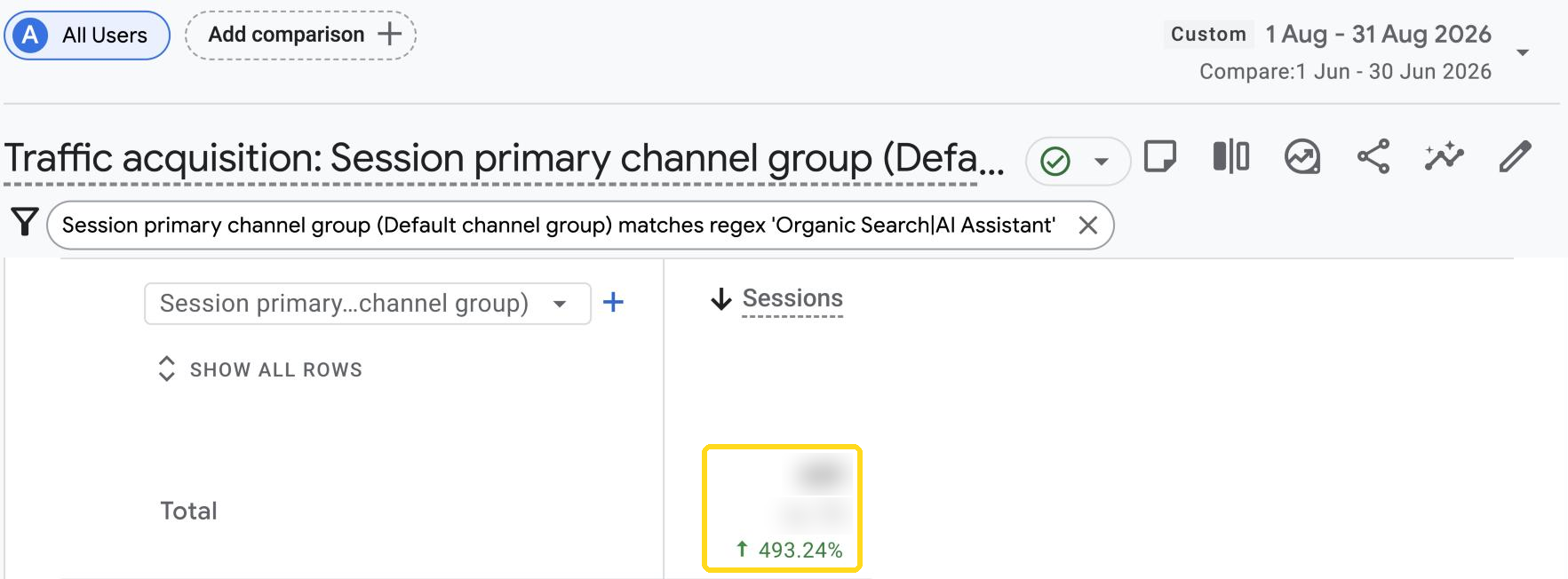
  • Result: +493% organic and AI search traffic from month 1 to month 3, and impressions in Google's AI answers up +676% between Search Console's first and latest 30 days.

New vs known.

AI already had its favourite app builders, and our client wasn't one of them. Getting a product AI had never seen into those answers took more than content: it took a reason to trust it.

The pain
A new AI app builder with no authority, up against Lovable and Replit.
The proof
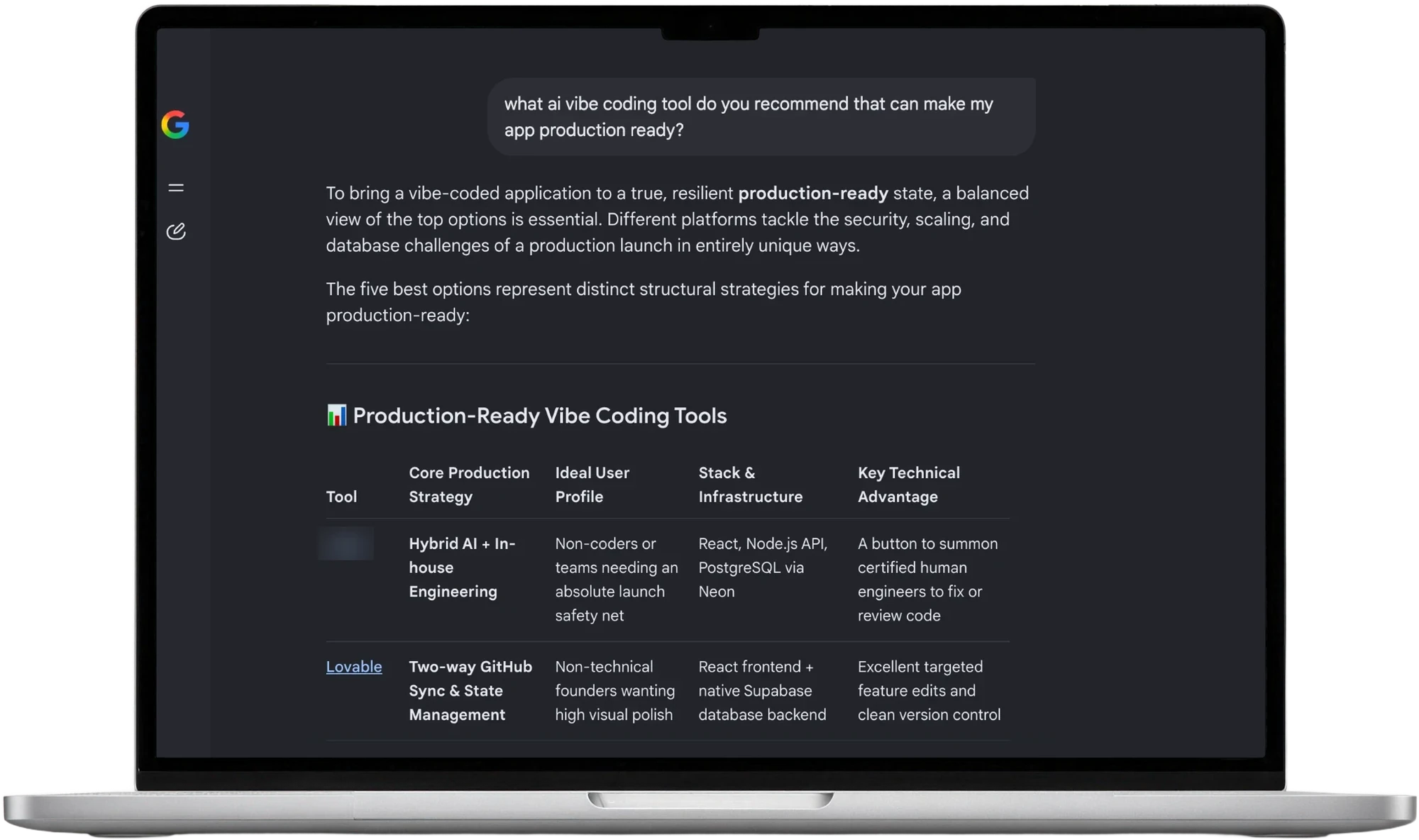
Six weeks after its first article, Google's AI answer named it above Lovable.
The outcome
AI + organic traffic up +493% in 3 months.
A laptop showing Google's AI answer to the buyer question: what AI vibe coding tool do you recommend that can make my app production ready? The client's product is the first tool in the answer's comparison table, above Lovable. Client name blurred under NDA.
Google's AI answer16 Aug 2026 · Client name blurred under NDA

The starting point

This AI app builder launched in June 2026. Its site had a homepage, a pricing page and help docs. There was no blog, no comparison pages and no third-party profiles.

In June 2026 we ran 129 real buyer questions through AI and read 2,580 answers. AI named the brand in 0 of them. The category leader was named in 41.4% of answers.

So the goal was clear. Build a site AI can read. Answer the questions buyers ask. Get the brand onto the sites AI trusts.

In their words

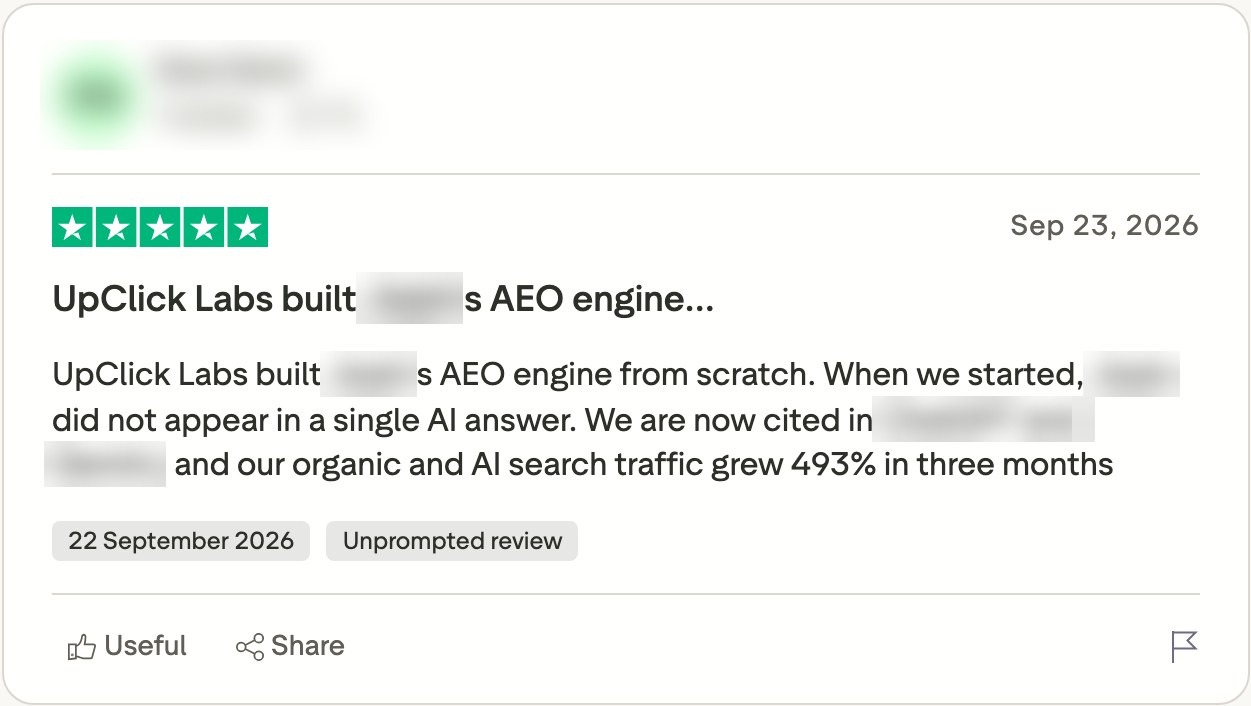
"UpClick Labs built [the product]'s AEO engine from scratch. When we started, [the product] did not appear in a single AI answer. We are now cited in [two AI assistants], and our organic and AI search traffic grew 493% in three months"
Founder, SaaS Startup FounderSaaS Startup · 5-star Trustpilot review, 22 Sep 2026
The founder's public 5-star Trustpilot review of UpClick Labs. The reviewer name, client name and AI product names are blurred.
Public Trustpilot review, 22 Sep 2026. Client and product names blurred under NDA.

What we shipped

The work behind the numbers, one pillar at a time. Client names are blurred under NDA.

  1. I · Intent

    Start where buyers already ask

    • A brand-new product has no search history to learn from. So we went where its buyers were already talking.
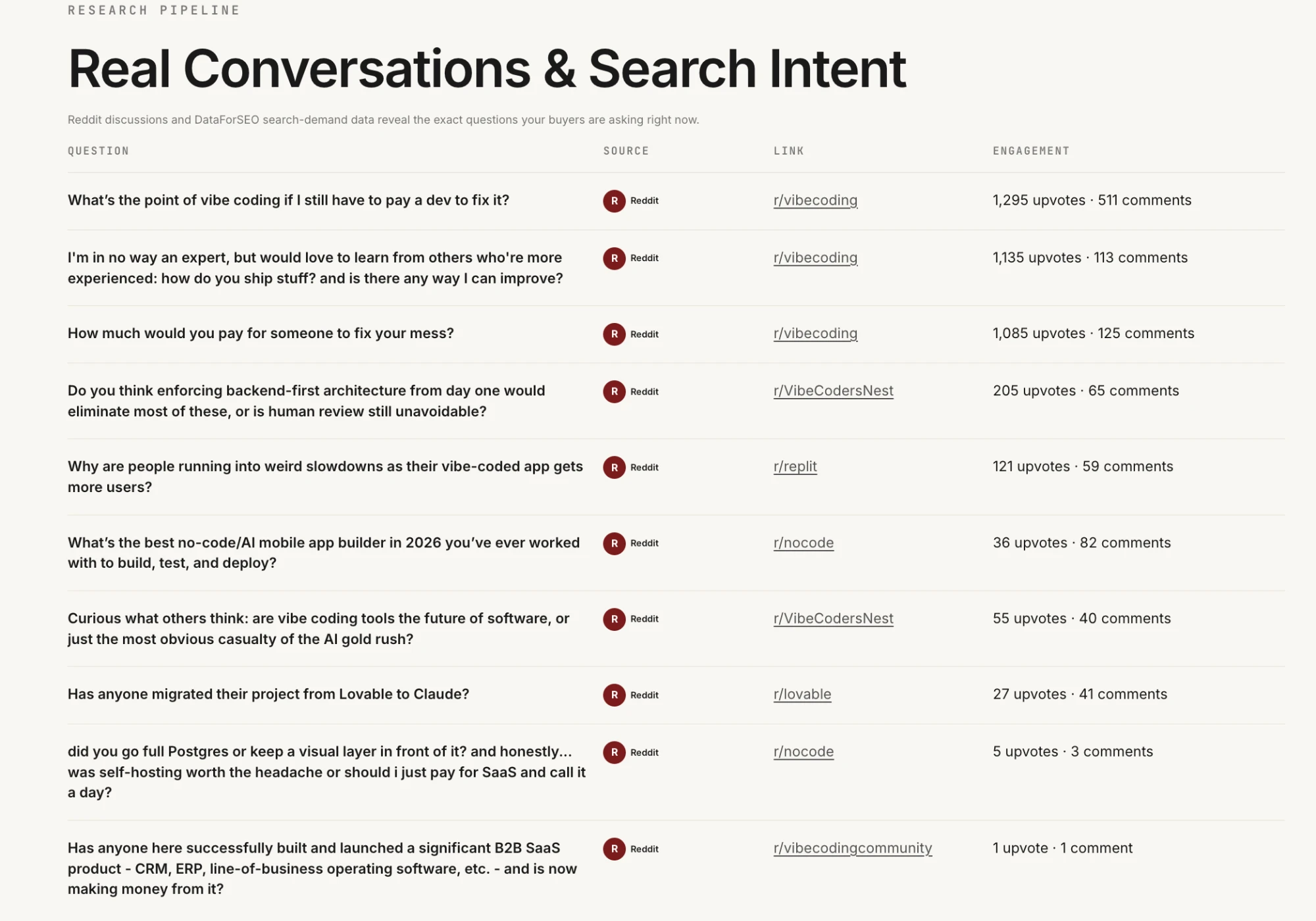
    • We pulled more than 1,000 Reddit posts and paired them with search demand data to find the questions people ask before choosing a tool.
    Our research pipeline: real buyer questions pulled from Reddit, each with its subreddit and engagement, led by what's the point of vibe coding if I still have to pay a dev to fix it, with 1,295 upvotes and 511 comments
    Real buyer questions from Reddit, ranked by engagementOur research pipeline, Reddit plus search demand data.
    • Then we put the questions to AI. Our first scan asked 4 AI engines 129 buyer questions, and not one of the 2,580 answers named the client.
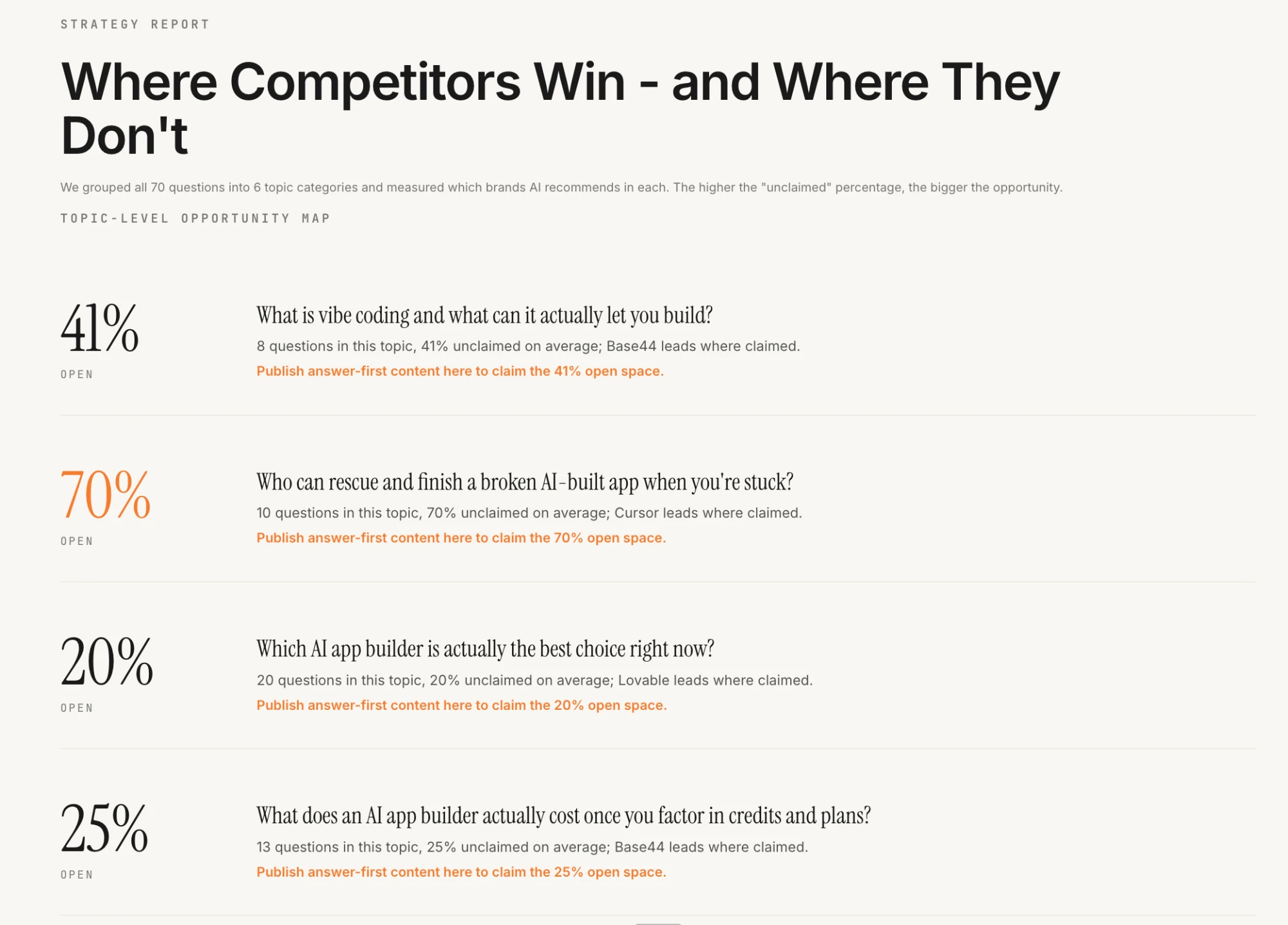
    • In July we locked 10 topic anchors and 36 question clusters. In August we rebuilt the set around 3 buyer types: 70 questions in 6 topics, with the brands AI recommended in each.
    • The gaps showed us where to start. On 68.6% of questions no brand owned the answer, and the client showed up in just 1.7%.
    Strategy report, topic-level opportunity map: four topics with the share of AI answers no brand has claimed, from 20% to 70% open, each with the brand that leads where claimed and a note to publish answer-first content there
    Where competitors win, and where nobody does yetStrategy report, August 2026. The higher the open share, the bigger the opportunity.
  2. C · Content

    Commercial pages AI can quote

    • Blog posts win the question, but commercial pages win the decision.
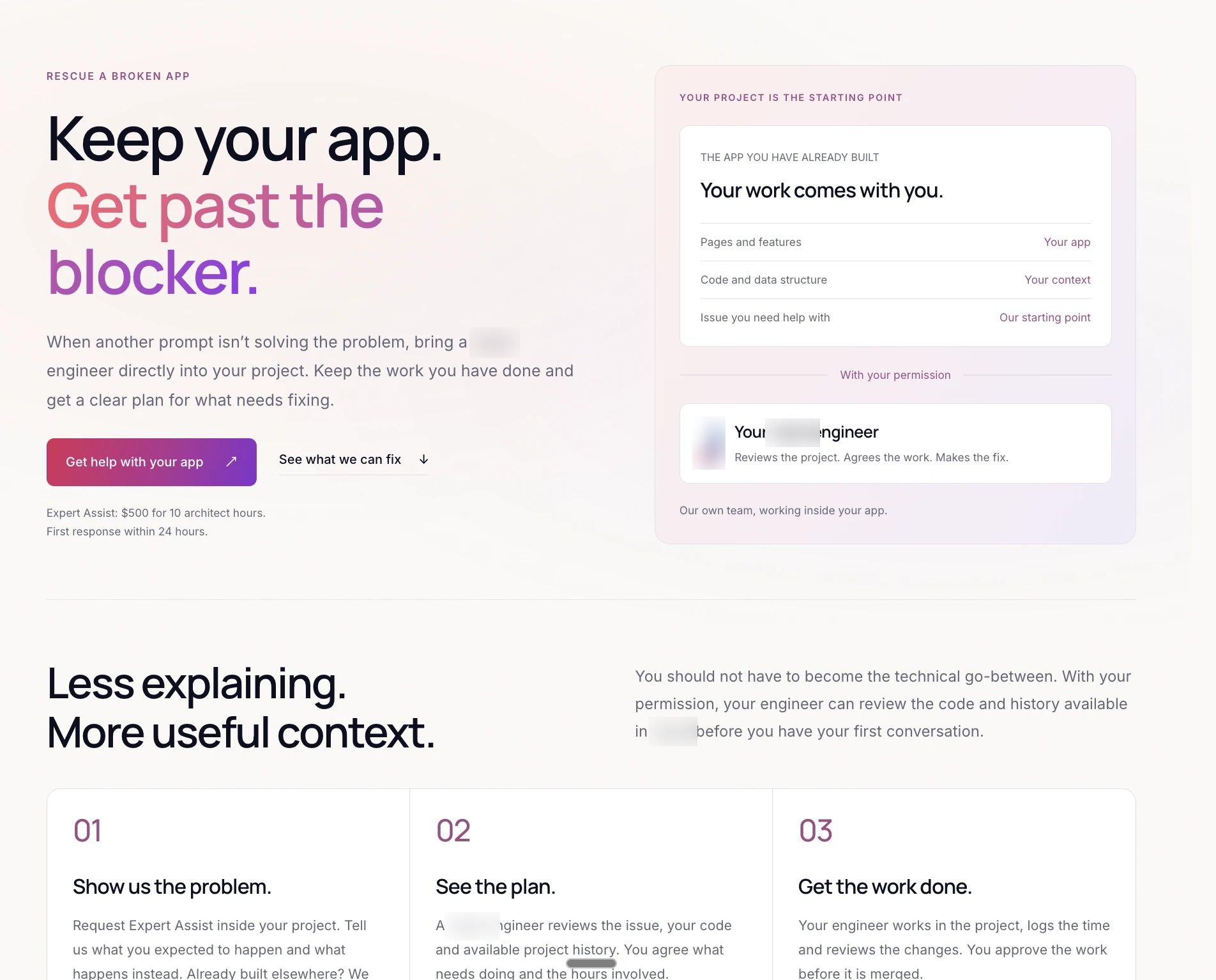
    • So we rewrote the pages buyers land on before they sign up: 3 solutions pages, one per buyer type, and 7 comparison pages with a short answer at the top.
    • We also rewrote the pricing page answer-first and fixed its schema, so every plan and price reads as a clear fact.
    The client's rescue-a-broken-app solutions page: the buyer's problem in the headline, a card showing the app they already built, and three steps from showing the problem to getting the work done. Client name and logo blurred.
    A solutions page for one buyer type: founders with a broken appClient site, September 2026. Client name blurred under NDA.
  3. T · Technical

    A graph that borrows 18 years of trust

    • AI needs to know who a company is before it will recommend it, and it has to be able to read the site first.
    • So we gave AI crawlers a map of the site: an llms.txt file that points them to the pages that matter.
    • We also found why deep pages served AI crawlers an empty shell. Their developer shipped the fix and we verified it.
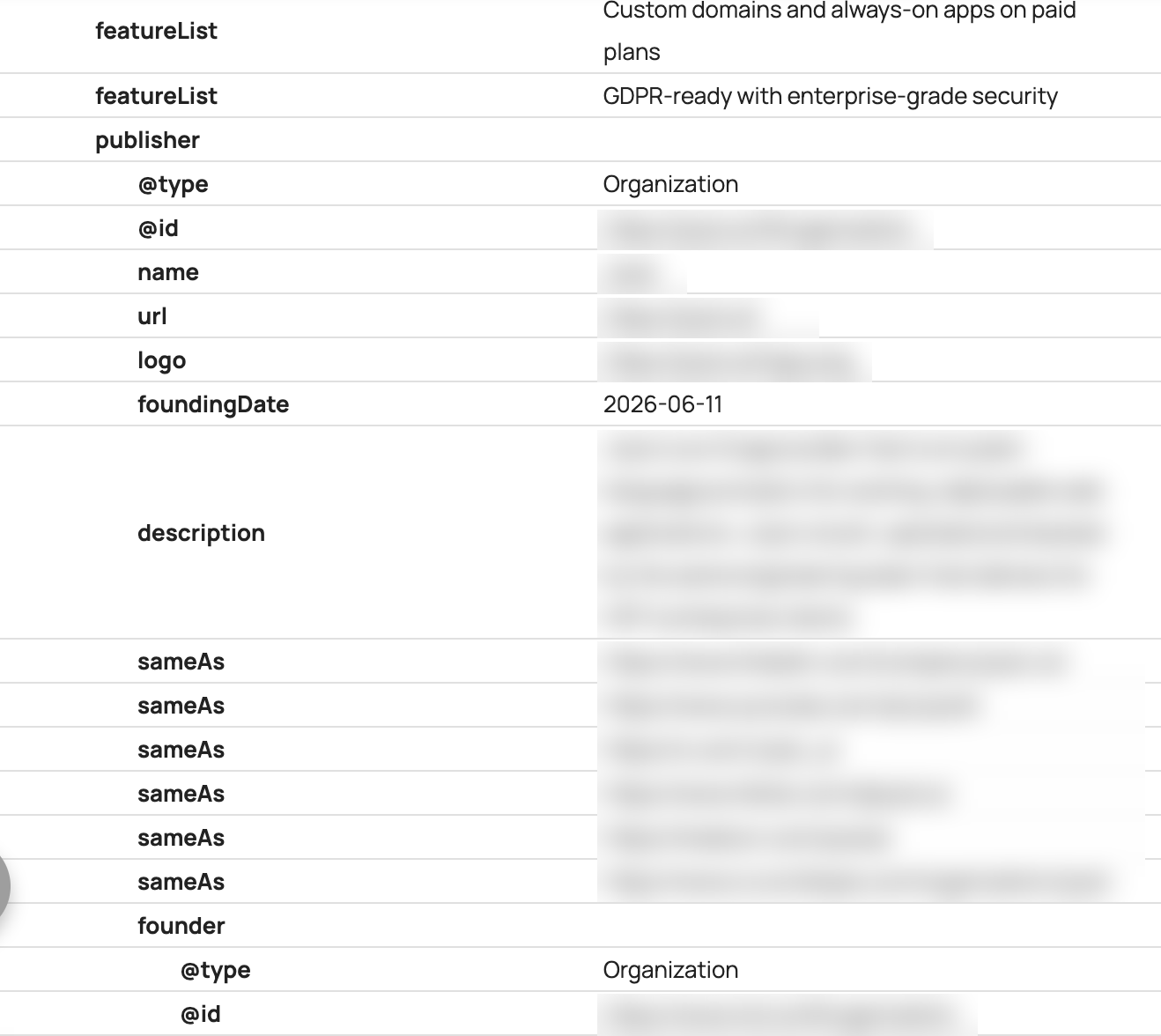
    • We built an entity graph that names the company, links every official profile back to it and carries its registration number.
    • Then we linked its sister company, with 18 years in software, into the same graph. The new brand had no track record yet, so it borrowed one that already existed.
    • By October, 15 schema types were live across the pages we checked.
    The client's entity graph in a schema validator: the publishing Organization with its founding date, description and six sameAs profile links, and the sister company linked as a second Organization. Names, URLs and description blurred.
    The entity graph: the brand, its profiles and its sister company in one recordClient homepage schema, October 2026. Names and URLs blurred under NDA.
  4. E · Evidence

    On the sites AI already reads

    • A new product has almost no reviews, so we built trust where AI looks for it.
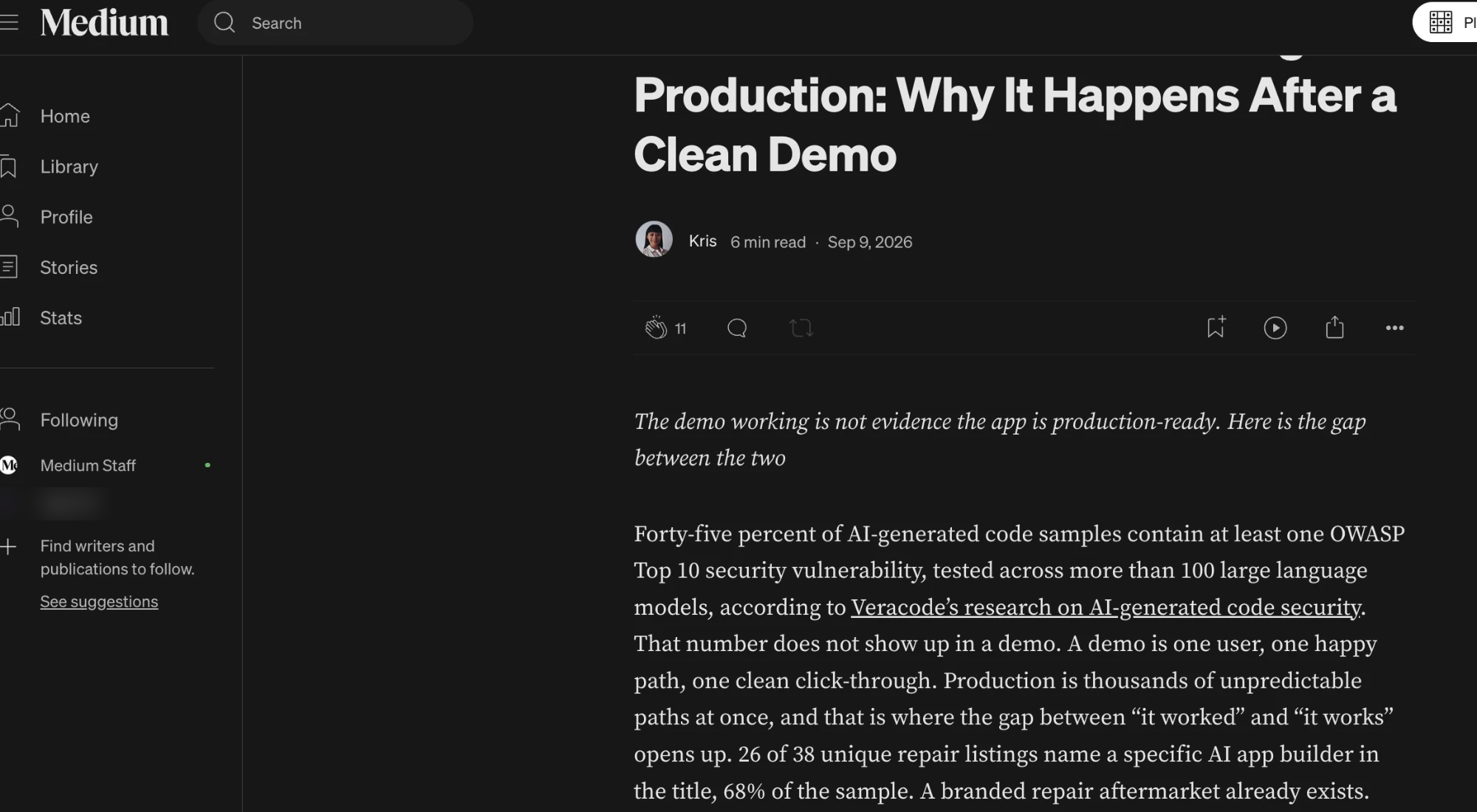
    • That meant articles on Medium and Dev.to, a Crunchbase profile, a Product Hunt page, an AlternativeTo listing, and guidance on joining Reddit threads.
    • Medium paid off: our tracking shows AI cites it in 9% of answers to the client's buyer questions.
    One of our articles on Medium, published 9 Sep 2026: why an AI-built app breaks in production after a clean demo, opening with a cited statistic on security flaws in AI-generated code. Client name blurred.
    One of 7 articles we published on Mediummedium.com, 9 Sep 2026. Client name blurred under NDA.
  5. S · Signals

    Data that told us where to aim

    • Our dashboard, live since July, tracks the client's buyer questions in AI every week and logs every site each answer links to. GA4 and Search Console sit right alongside.
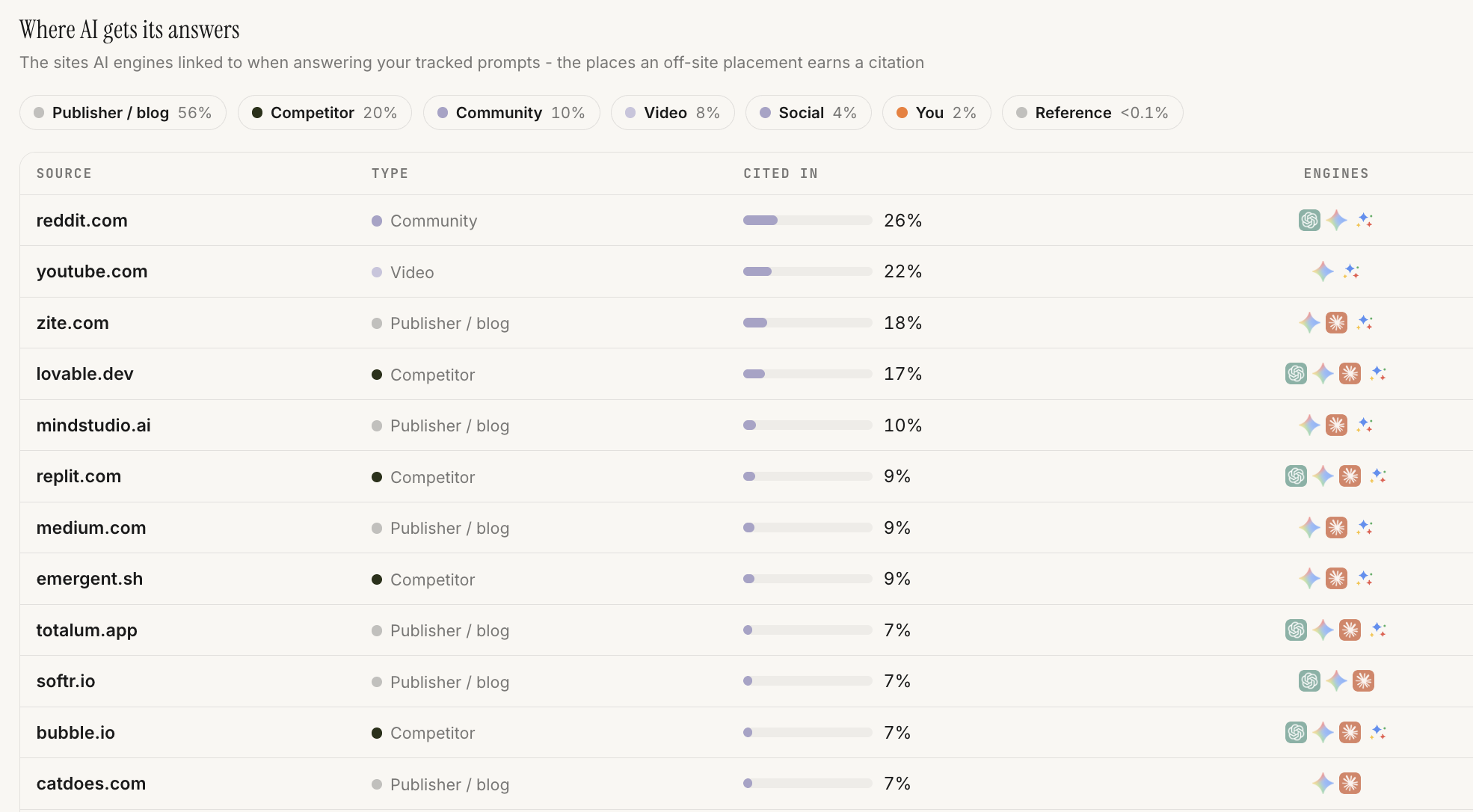
    • That told us where to focus: community threads and publisher blogs feed most answers.
    • It also surfaced competitors we didn't know existed, all fighting for the same questions. That's where the comparison pages came from.
    • At three months, a report reconciled every number across GA4, Search Console and our dashboard.
    Where AI gets its answers, in our dashboard: the sites AI linked to when answering the client's tracked questions, split into publisher and blog 56%, competitor 20%, community 10%, video 8%, social 4% and the client 2%, led by reddit.com in 26% of answers
    Where AI gets its answers: every site linked in answers to the client's tracked questionsOur dashboard. Icons show which AI engines cited each site.

How we measured

  • Traffic. Organic search and AI sessions in the client's own GA4, month 3 (1-31 Aug 2026) vs month 1 (1-30 Jun 2026). Work started 16 Jun 2026.
  • Google. Search Console has no data before 5 Jul 2026, so we compare its first 30 days (5 Jul-3 Aug) with the latest 30 (4 Sep-3 Oct 2026).
  • AI answer baseline. A June 2026 scan of 129 buyer questions read 2,580 AI answers. None of them named the brand.
  • NDA. The client's name is blurred in every capture, and session counts are hidden.

The results

BeforeWhen we startedTraffic: June 2026, our first month. Google: 5 Jul-3 Aug 2026, the first 30 days Search Console recorded.
AfterThree months inTraffic: August 2026, our third month. Google: 4 Sep-3 Oct 2026, the latest 30 days.

Measured in the client's own GA4 and Search Console. The original report sits under every chart.

Organic and AI search sessions

+493%

In its first month, the brand-new site drew a trickle of search visits. By month three, sessions from organic search and AI assistants were up +493%.

1-30 Jun vs 1-31 Aug 2026
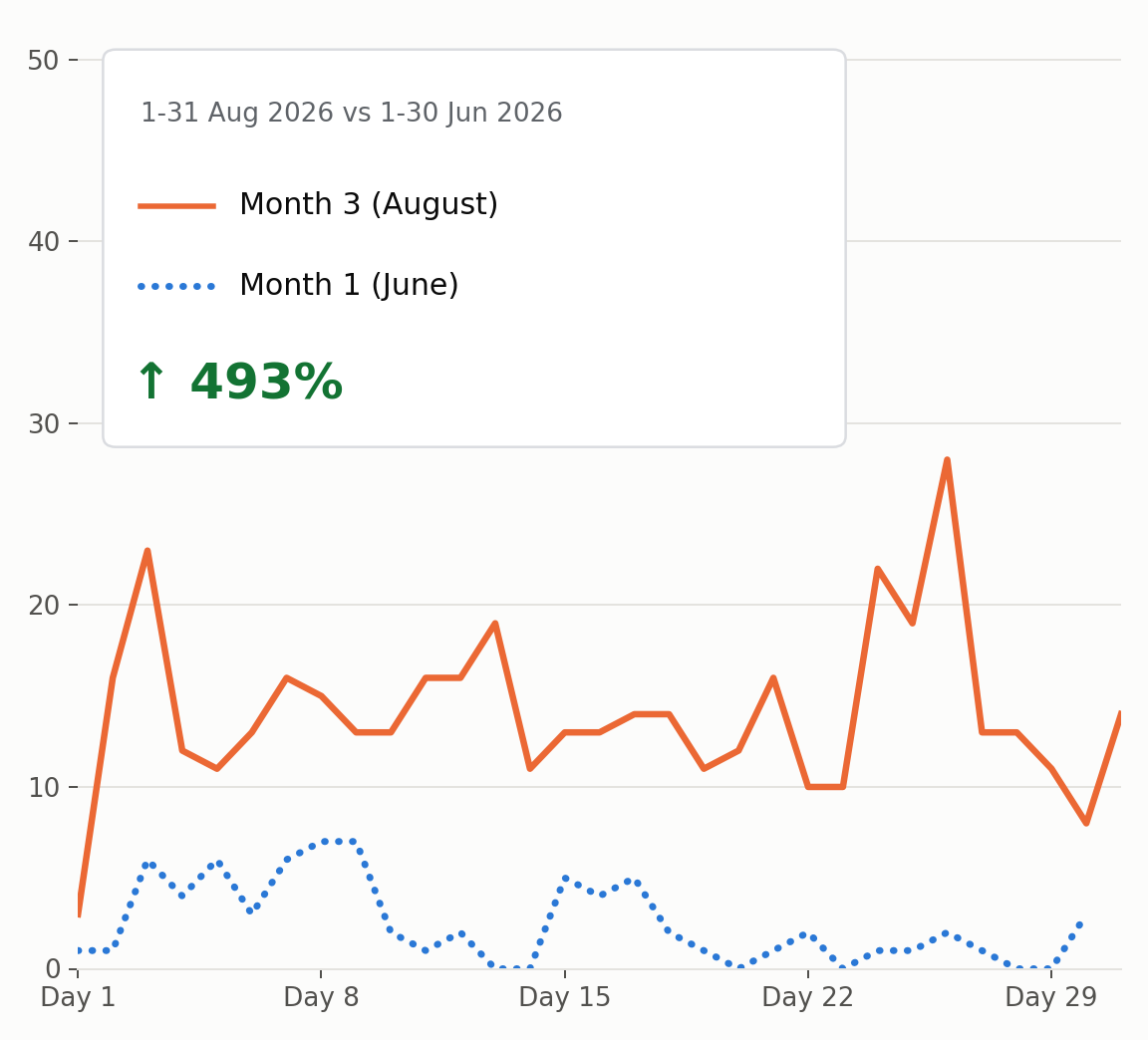
Line chart of organic and AI search sessions per day. August 2026 runs well above June 2026 on almost every day of the month. Up 493%.
Google Analytics traffic acquisition report filtered to the Organic Search and AI Assistant channels, 1-31 Aug 2026 compared with 1-30 Jun 2026. The total, boxed in yellow: sessions up 493.24%. Session counts blurred.
Original GA4 dataOrganic Search and AI Assistant channels. Session counts blurred.

Impressions in Google's AI answers

+676%

Google now shows the site inside its AI answers far more often: +676% from the first 30 days of data to the latest 30. Most of those appearances go to blog articles we wrote.

5 Jul-3 Aug vs 4 Sep-3 Oct 2026
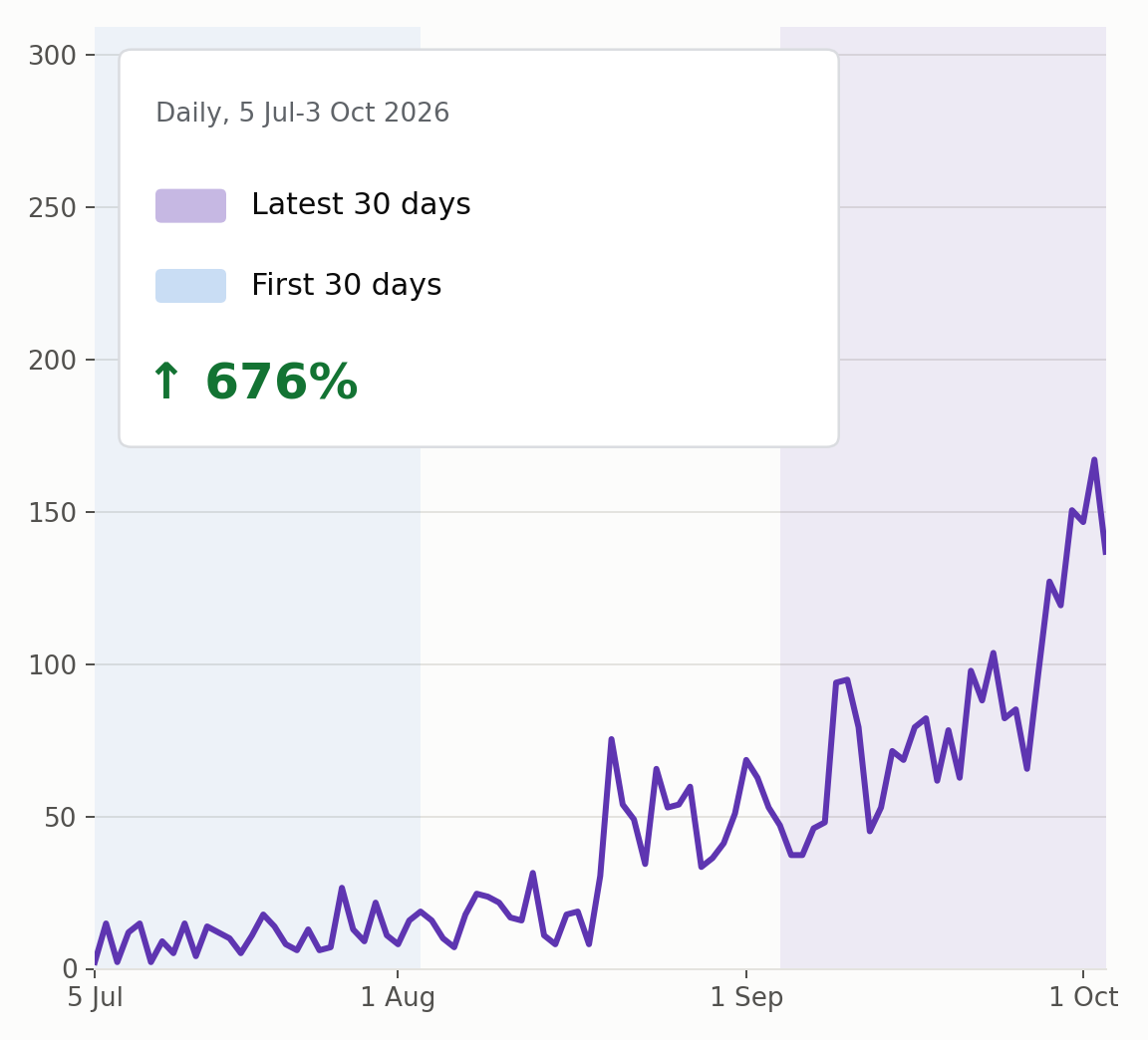
Line chart of daily impressions in Google's AI answers, 5 July to 3 October 2026. Under 30 a day through July, then a steady climb to over 150 a day by early October. Up 676%, first 30 days vs latest 30 days.
Google Search Console Generative AI features report in compare mode, 4 Sep-3 Oct 2026 vs 5 Jul-3 Aug 2026, total impressions boxed in yellow: 2.55k in the latest 30 days vs 329 in the first 30 days.
Original Search Console dataGenerative AI features report (Beta). 329 impressions in the first 30 days, 2.55k in the latest 30: +676%.

Searches that don't name the brand

+1,372%

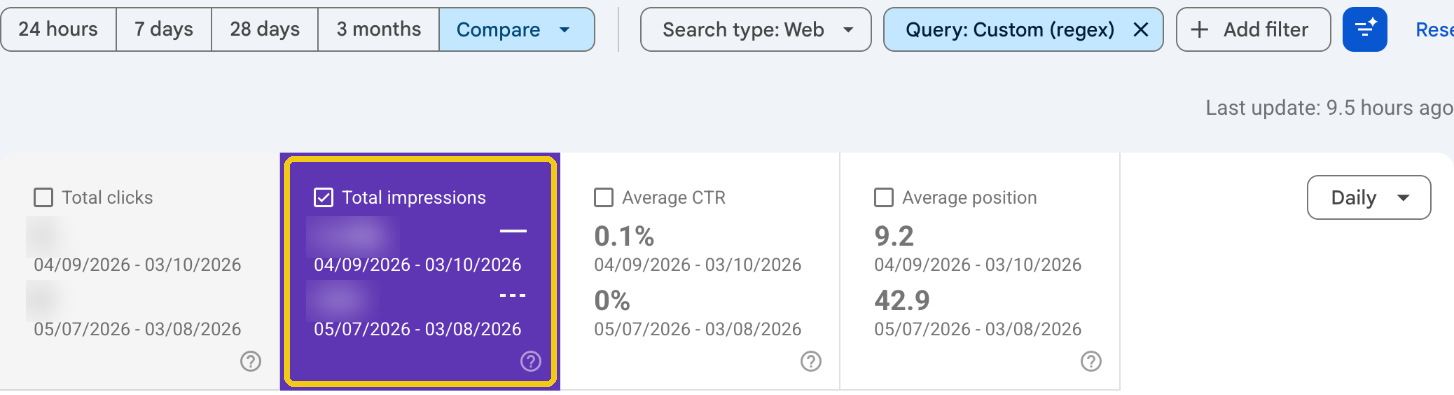
These are people searching for an answer, not for the client. Google showed the site to them +1,372% more often, and its average position rose from 42.9 to 9.2, onto page one.

5 Jul-3 Aug vs 4 Sep-3 Oct 2026
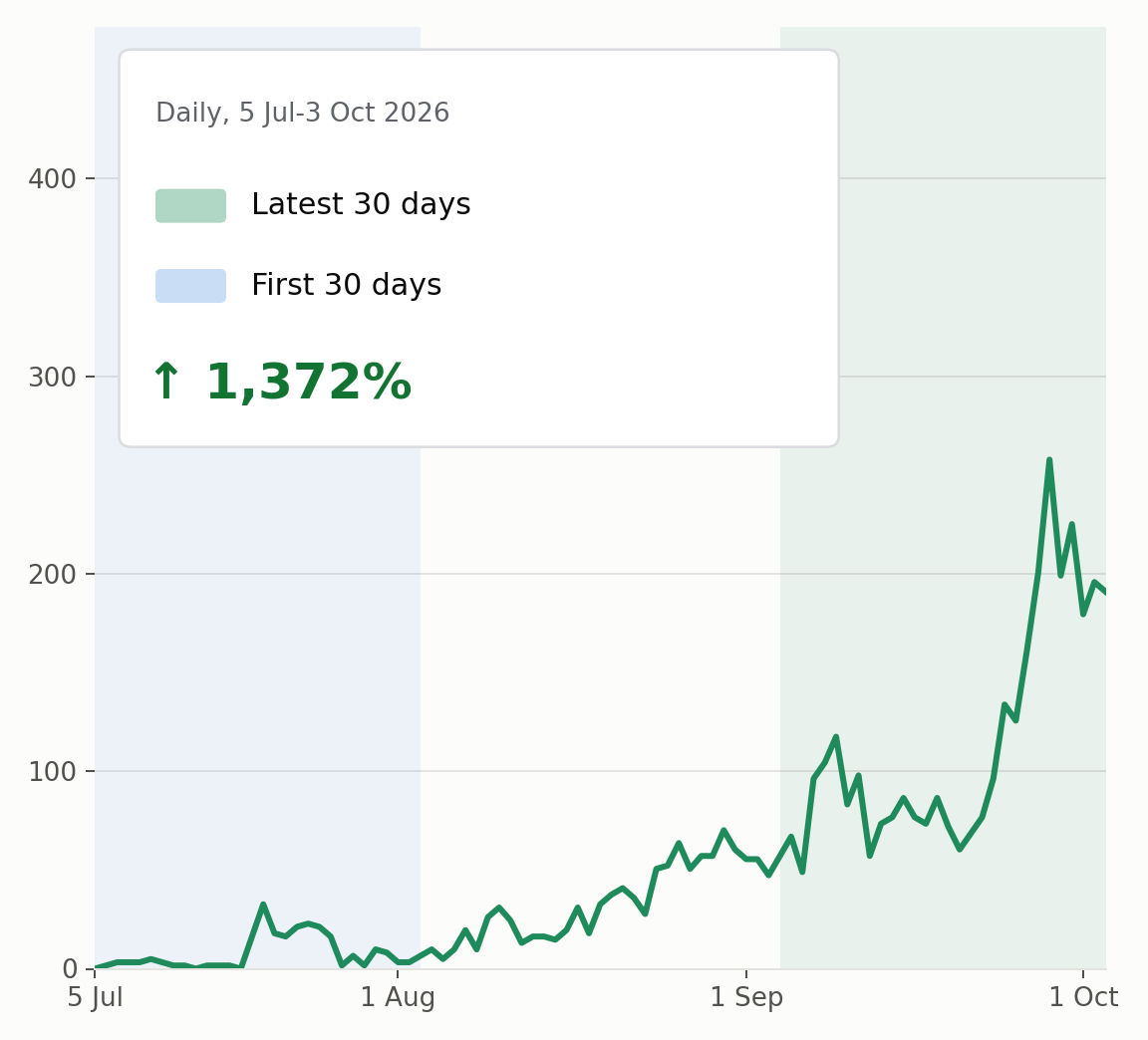
Line chart of daily Google impressions for searches that don't name the brand, 5 July to 3 October 2026. Near zero in July, rising through August and September to around 200 a day. Up 1,372%, first 30 days vs latest 30 days.
Google Search Console performance report in compare mode, 4 Sep-3 Oct 2026 vs 5 Jul-3 Aug 2026, filtered to queries that don't match the brand name. Total impressions boxed in yellow, counts blurred. Average position 9.2 vs 42.9.
Original Search Console dataWeb search, every query that doesn't contain the brand name or its misspellings. Click and impression counts blurred.

In summary

  1. 01

    Starting point

    A brand-new site with a homepage, a pricing page and help docs. No blog and no third-party content. AI named the brand in 0 of 2,580 answers.

  2. 02

    Strategy

    Map the buyer questions AI answers and build a page for each. By early October that meant 7 comparison pages, 3 solutions pages, 2 research reports and 7 off-site articles, on a site AI crawlers can read.

  3. 03

    Results

    By month three, organic and AI search traffic was up +493% (June vs August 2026). From the first 30 days of Search Console data to the latest 30, impressions in Google's AI answers grew +676% and impressions for searches that don't name the brand grew +1,372%. Six weeks after the first article went live, Google's AI answer named the client first for a buyer question.

Free AI visibility score

See where you stand.
Then own the answer.

See where AI names you today, where it doesn't, and the one gap to fix first. Two minutes, no call.

Own the answer. Own the sale.

Last updated